


Course Content
Seven focused, hands-on modules
Delivery is structured around concise, hands-on learning modules:
01 Introduction to PAT Testing and Electrical Equipment
The day opens with a solid grounding in what PAT testing actually is and why it sits at the centre of any responsible electrical safety programme. We define the key terms used throughout the industry so that every subsequent module makes immediate sense, and we place PAT testing in the context of an organisation's broader duty to manage electrical risk.
You will be introduced to the full range of equipment categories you will encounter as a tester — portable, movable, hand-held, stationary, fixed and IT equipment — and to the three equipment classes (Class I, Class II and Class III) that govern how an appliance guards against electric shock. Grasping these distinctions at the outset is vital, because an appliance's class and category determine which tests must be applied throughout the rest of the course.
02 Electrical Safety, Electrical Dangers and Relevant Legislation
Effective PAT testing starts with a clear understanding of what can go wrong with electrical equipment and why. This module examines how electricity injures people — through electric shock, burns and fire caused by faulty or deteriorating appliances — and the conditions that allow otherwise manageable equipment to become dangerous.
From hazards we move to law. You will work through the Health and Safety at Work etc. Act 1974, the Electricity at Work Regulations 1989, the Provision and Use of Work Equipment Regulations 1998 (PUWER) and the duties they impose on employers, employees and the self-employed. We tackle the most persistent myth in the industry head-on: there is no legislation that specifically mandates PAT testing, yet duty-holders are unambiguously required by law to keep electrical equipment safe, and regular inspection and testing is the accepted method of proving they have done so. You will leave this module knowing exactly who carries that duty and what the phrase "reasonably practicable" means for day-to-day decisions.
03 Visual Inspections and Equipment Construction
Experienced testers know that the visual inspection finds far more faults than the meter does. This module teaches you to conduct a methodical formal visual inspection and to spot the damage, wear patterns and misuse signs that mean an appliance must be removed from service immediately — before a single test lead is connected.
We dig into the construction details that matter: correct plug wiring to BS 1363, appropriate fuse selection, the condition of cables and flexible leads, strain relief arrangements, and the integrity of casings and terminal connections. We explain how an appliance's construction relates to its equipment class, and draw a clear distinction between the routine user checks that every member of staff should perform and the formal visual inspection that demands a competent person.
04 Practical Instruction Using PAT Testing Equipment
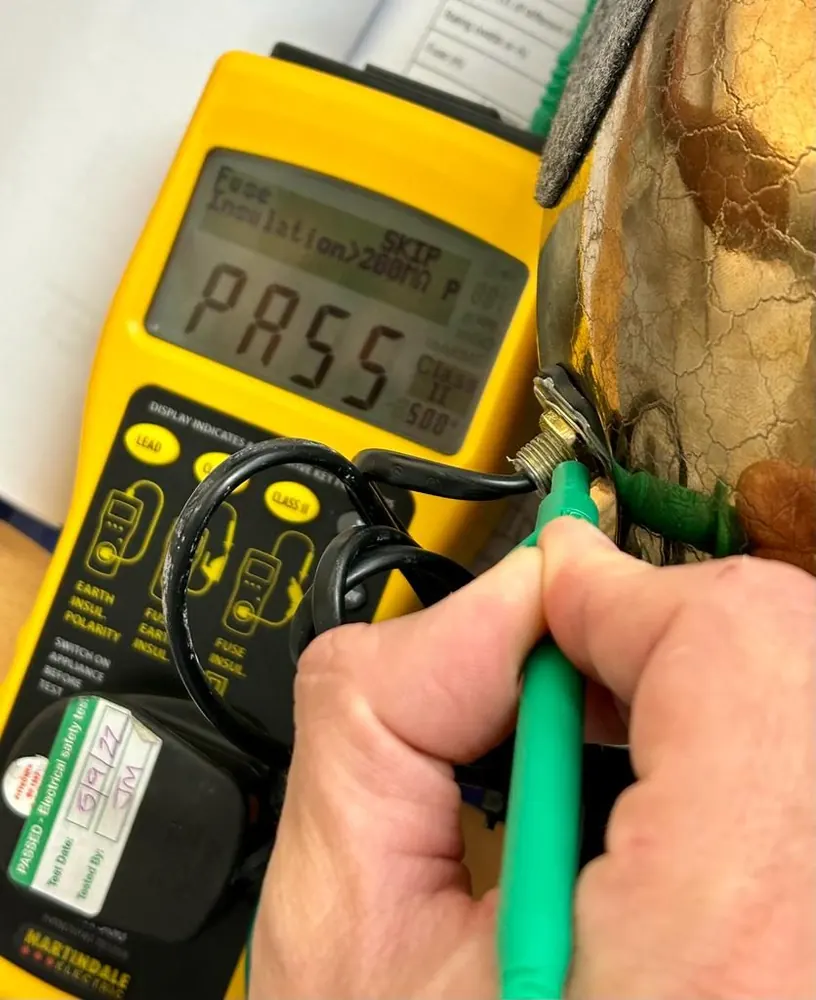
This is the module where the course turns truly hands-on. Working directly with real PAT testing instruments in our learning zone, you will practise setting up and operating the equipment safely, correctly and with growing confidence. We introduce the range of testers you are likely to encounter in professional practice, from straightforward pass/fail units through to advanced downloadable instruments capable of storing and exporting results.
You will connect appliances correctly, appreciate why calibrated equipment is non-negotiable, and develop the practical familiarity that only comes from repeated, supervised use. By the time this module closes, reaching for a PAT tester will feel entirely natural.
05 Inspection and Testing Procedures
With the instrument in hand, you will now learn the formal test sequence and how to apply it to different appliance types. The module works through every core electrical test in turn — earth continuity testing, insulation resistance testing, lead and polarity checks, and functional checks — explaining the purpose of each and exactly what a result tells you about the condition of an appliance.
You will learn precisely how the test sequence differs between Class I and Class II equipment, ensuring you always select and order the correct checks. Safe working practice runs as a constant thread through the module: every test you carry out on this course, and in your future work, must be both technically correct and operationally safe.
06 Interpreting Test Results and Record Keeping
Obtaining a reading is only half the job — knowing what to do with it is the rest. This module teaches you to compare results against accepted limits, reach a sound pass or fail decision, and take the right action when an appliance fails. You will also learn how to label tested equipment clearly and maintain the kind of structured records that stand up to scrutiny.
We turn next to retest intervals and the risk-based methodology at the heart of the current IET Code of Practice, which deliberately moves away from the rigid fixed-frequency tables of earlier editions. You will learn to set inspection and testing frequencies by weighing up equipment type, operating environment, frequency of use and the profile of the user. Clear, well-maintained records and a reliable asset register are presented as the foundation of any defensible ongoing compliance position.
07 Legal Requirements, Non-Statutory Requirements and the IET Code
The final module draws everything together and roots your new skills firmly in their regulatory context. You will understand the distinction between statutory duties — the legislation you are legally bound to follow — and non-statutory guidance — the recognised best practice that shows how to comply — and why both matter when you carry out PAT testing professionally.
Central to this module is the IET Code of Practice for In-Service Inspection and Testing of Electrical Equipment, now in its 5th edition. We walk through what the Code says, how it supports and interprets the underpinning legislation, and how to use it as your go-to reference in the field. You will finish the course with a confident, practical understanding of what competence means in PAT testing, how to demonstrate due diligence, and how to work to a professional and fully defensible standard every time.
A substantial portion of the day is devoted to hands-on practice in the learning zone using live testing equipment.